The Jami Initiative: Becoming Trauma Informed, by Rifqa Bolliger (a two-part class plus Case Study Review)

Register for the Case Study Review
Dates: This was a two-part class on: Saturday Sept 19 and Saturday Oct 3
Time: 11:00am-2:15 pm PT/ 2:00pm-5:15 pm ET
Length: 3-hour, 15 minute session each
Please register below to receive the recordings and handouts in a separate email.
Case Study Review | Becoming Trauma Informed with Rifqa Bolliger
"*" indicates required fields
A Two-Part Class Sponsored by SSC and the Jami’ Initiative
Saturday September 19th (3-hour, 15-minutes session): 11:00 AM-2:15 PM PT / 2:00 PM-5:15 PM ET
Saturday October 3rd (3-hour, 15-minutes session): 11:00 AM-2:15 PM ET / 2:00 PM-5:15 PM ET
Anyone who works with people–especially in the healing/ helping/ teaching/ caregiving/ peacemaking arenas–will run into trauma.
But what is trauma? How do we recognize it? Is it the same or different from other forms of distress – and does that matter? What should we do when it arises – when someone in our care, or a fellow community member, suddenly shuts down? an interaction goes off the deep end, seemingly out of nowhere? when someone is upset beyond what the immediate situation would typically evoke?
This 2-part class will:
- give attendees a basic foundation for recognizing and understanding trauma as it plays out within the body, emotions, thoughts and observable behaviors
- address what kinds of actions can help or hinder, when unresolved, historic trauma, or in-the-moment threat responses arise
- examine the role that Sufi spiritual-, and other similar practices play in developing resilience and promoting recovery
- provide strategies for managing traumatic activation, in the moment
- help us become more aware of how trauma may be showing up within our own experience
This class is especially geared towards healers, teachers, community leaders and mediators in the Shadhiliyya Sufi Community, but all beloveds are welcome to attend. Course contents are applicable across any setting in which we interact with others.
Please note: While the information and skills presented will also be applicable to ourselves, this class is not intended as a space for individuals to work on their own healing.
Part 1: States of Threat and Safety – required for attending Part 2
Our experience organizes our physiology, and our physiology organizes our experience. Using simple, graspable concepts; limited terminology; our own experience; and relatable, common situations, part 1 will explore:
- the neurobiology and lived experience of feeling safe
- the neurobiology and lived experience of various response strategies to perceived threat
- how experience and physiology create each other
- why it’s so much easier to get sucked into defensive reactivity than to stay grounded and feeling safe
- how Sufi practices and other activities can impact these states, and our capacity to move between them
- self-regulation: navigating ourselves back to a sense of safety
Part 1 provides foundational concepts necessary for understanding trauma, which we will address directly, in part 2. No prior knowledge of anatomy or physiology is required.
Part 2: Understanding Trauma – prerequisite: Part 1
Part 2 builds on the concepts learned in part 1, to develop a well-rounded understanding of trauma and how (and whether) to help, when someone’s trauma gets reactivated. Class topics will include as many of the following as possible:
- what trauma is and isn’t
- how people become traumatized
- habituated responses: adaptive then, maladaptive now
- lack of support: the nail in the coffin
- loss of connection is a threat to survival
- how trauma is the same or different from other forms of stress or threat responses
- traumatic stress vs. post-traumatic stress disorder (PTSD)
- shared experience/different outcomes – why some people become traumatized and others recover
- resilience and the role of resources
- trauma therapy vs. helping in the moment: what to do, and not do, when someone in our care, or community, is triggered
- support, containment and co-regulation: helping others regain their sense of safety
- time allowing: questions from participants’ about prior experiences as the person holding the container, when someone else’s trauma history engaged.
What This Course is Not
IMPORTANT: This course is designed to give lay people and non-mental health professionals basic working knowledge of trauma, and how to help when unresolved trauma patterns emerge in our interpersonal interactions or professional engagements with others.
This course does NOT equip anyone to call themselves a trauma therapist or specialist, nor provide adequate training to support others through extended trauma-healing journeys.
Trauma presents in many, many ways. Helping people recover from trauma (as opposed to managing activation, in the moment) takes a lot of training; the potential to increase the damage is real. Anyone interested in doing such work is highly encouraged to look at the Somatic Experiencing® training program, at https://traumahealing.org/training.
Class Details
- Each class will be about three and a quarter hours long, with 1 or 2 breaks. We may run slightly over or under depending how the content unfolds.
- We strongly encourage our community to attend this training live, if at all possible. This will allow you to ask questions and benefit from the community support of the group.
- The classes will be recorded if you cannot attend live. Attending live or viewing the recording of part 1 is prerequisite for attending part 2.
About Our Teacher, Rifqa Bolliger
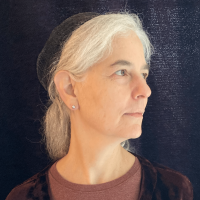
Rifqa Erica Bolliger has been a spiritual seeker, healer and physiology geek her entire life. She took hand with Sidi in 2003, while a student at the Jaffe School of Spiritual and Medical Healing; holds a self-designed BA in Holistic Health from Oberlin College; earned her Master of Divinity through USHS’s Ministry program; and is a Muqqadam in the Shadhiliyya tariqa.
Rifqa has been a certified Somatic Experiencing® (trauma recovery) practitioner since 2000; a trained DARe practitioner (attachment injury recovery) since 2023; a certified functional nutritionist since 2009; and licensed massage therapist since 1990 [OR lic. #5579].
A former gymnast, dancer, and anatomy, physiology and pathology teacher at massage schools on both sides of the country, Rifqa excels at making complex physiologic concepts accessible to anyone, and hopes always, to convey the wonder, magic and mystery of the amazing, holy body-heart-minds that Allah has given us. Subhanallah!
Rifqa can be reached through her private practice, Pacific BodyMind Therapies, at 503-236-9618 or info@pacificbodymindtherapies.com, where she sees clients both virtually and in person.
Register for Becoming Trauma Informed, by Rifqa Bolliger (a two-part class)
Date: Octber 31, 2026
Time: 11:00 am – 2:15 pm PT / 2:00 pm – 5:15 pm ET
Length: 3-hour, 15 minute session
Requirements: Watch Parts 1 & 2 and review all handouts before class
Scroll down and register for Parts 1 and 2 if you have not already done so.
"*" indicates required fields